VPS vs Shared Hosting: When to Make the Move

%203.png&w=256&q=75)
What Is a VPS?
A Virtual Private Server (VPS) gives you a guaranteed slice of a physical server. Using hypervisor technology (KVM on most modern providers), a single physical machine is divided into isolated virtual machines, each with dedicated RAM, vCPU cores, and disk. Your site's performance is not affected by other tenants.
A VPS gives you root access to the operating system. You choose the Linux distribution, install any software, configure Nginx or Apache exactly as your application needs, run any PHP version, and deploy any number of websites on the same server. On DigitalOcean, a 2 vCPU / 2 GB RAM Droplet starts at $18/month. On Hetzner, 2 vCPU / 4 GB RAM costs about $5/month — making VPS hosting significantly more cost-effective than managed alternatives once you have the tooling.
Key Differences: Performance, Control, and Cost
The differences between shared hosting and a VPS are not just technical — they affect how your site performs, what you can deploy, and your total cost as you scale.
Signals That You've Outgrown Shared Hosting
Move to a VPS when you encounter any of these conditions — not after they cause downtime:
Shared to VPS Migration Checklist
A migration from shared hosting to a VPS follows a predictable sequence. The goal is zero-downtime: you build the new environment, test it, then switch DNS only when everything is confirmed working.
"The biggest risk in a migration is rushing the DNS switch. Build, test, confirm — then cut DNS. Keep shared hosting active for a week as your fallback. The cost of one extra week of shared hosting is always less than a failed migration."
VPS Made Simple with CloudStick
The barrier that keeps developers on shared hosting is not cost — it is the complexity of managing a Linux server. Configuring Nginx, PHP-FPM, MySQL, Let's Encrypt, cron jobs, and backups from scratch takes hours. And unlike shared hosting, if you misconfigure something, there is no support team to fix it.
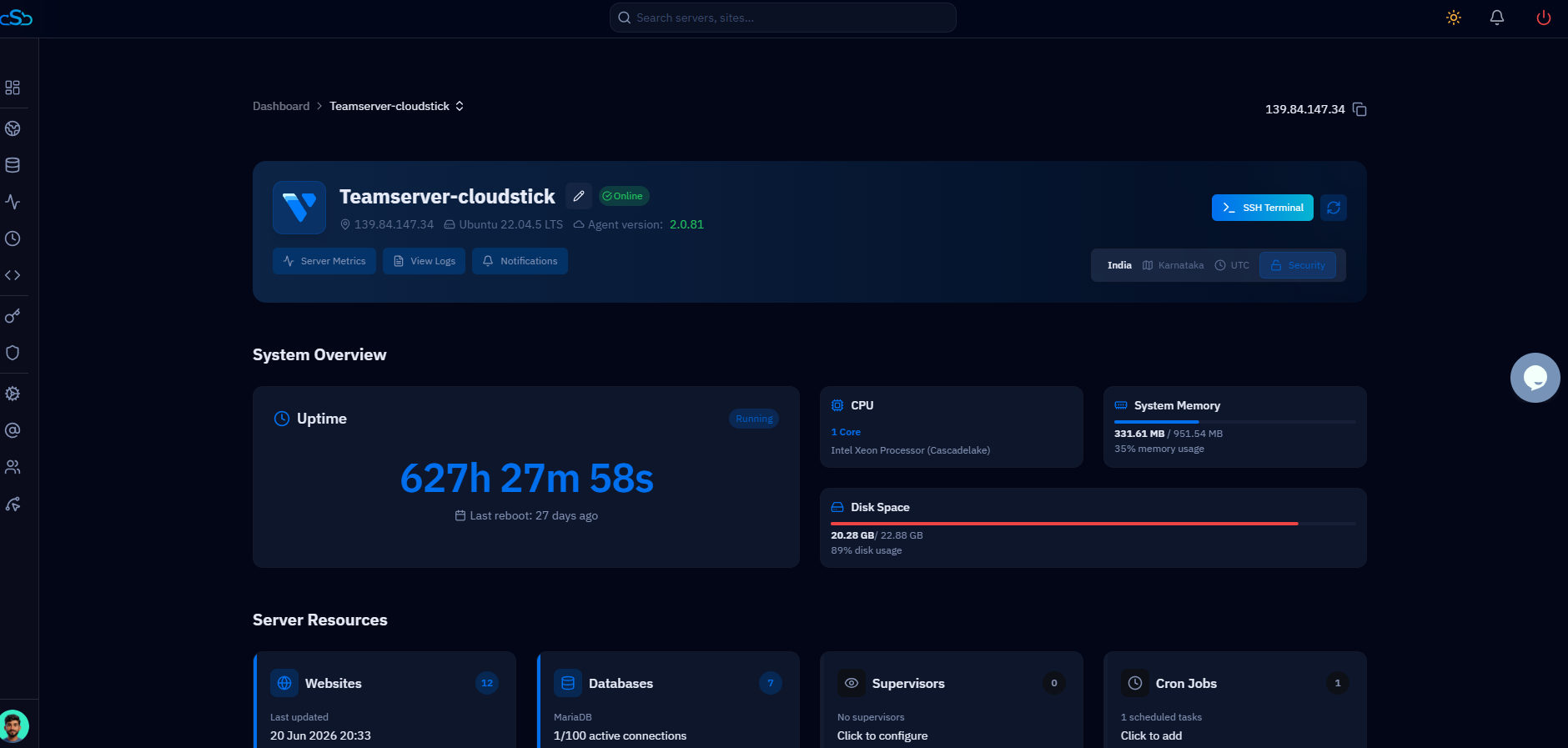
CloudStick eliminates this barrier. Connect your VPS — from DigitalOcean, Vultr, Hetzner, AWS, Linode, or Contabo — and CloudStick installs a production-ready LEMP stack in under 3 minutes. Deploy a WordPress site, issue a free SSL certificate, configure PHP 8.3-FPM, and set up automated daily backups, all from a web dashboard without touching the terminal.
Unlike Cloudways or Kinsta managed hosting, CloudStick charges a flat $9/month per server — not per site, not as a markup on compute. You pay your cloud provider directly for the VPS, and you pay CloudStick $9/month for the management layer. If you cancel CloudStick, your sites keep running — nothing depends on it staying active. That is the key difference from managed hosting platforms: your infrastructure stays yours.