CloudStick vs ServerPilot: A Detailed Comparison

%203.png&w=256&q=75)
What Happened to ServerPilot
ServerPilot launched in 2013 as one of the first SaaS-based server control panels. For its time, it was genuinely innovative: connect your DigitalOcean or Linode VPS, and ServerPilot would configure Apache, PHP-FPM, and MySQL automatically. Developers appreciated the simplicity. You didn't need to manage server configs by hand — ServerPilot handled the stack so you could focus on deploying applications.
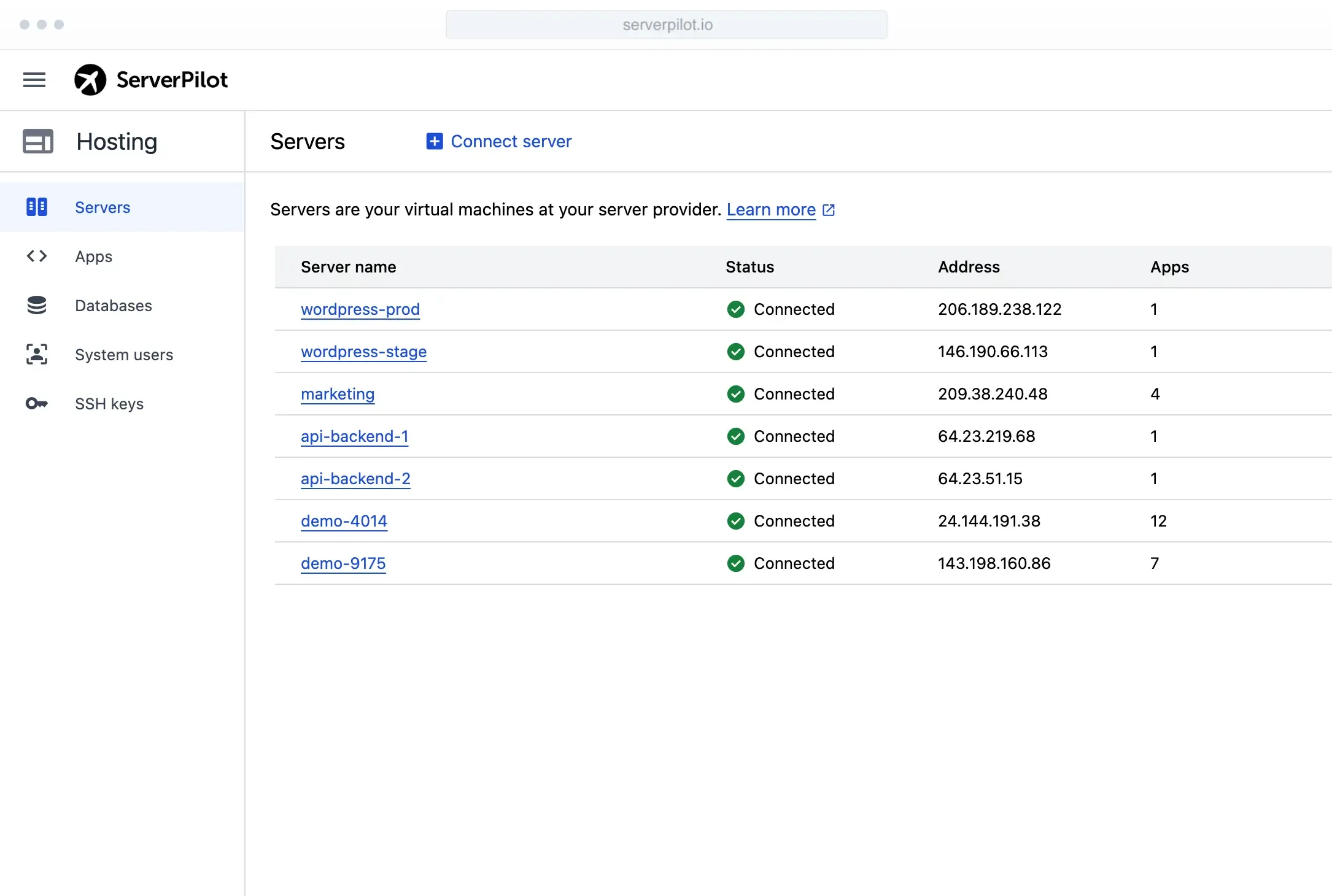
The problem is that ServerPilot has barely changed since those early years. The company released incremental improvements through 2017 and 2018, but meaningful new feature development has been largely absent for years. The dashboard looks the same as it did half a decade ago. The feature set hasn't expanded to match what the hosting industry now considers standard. Requests for email hosting, a visual database manager, or deeper firewall controls have sat unanswered in community forums for years.
This stagnation wouldn't matter if ServerPilot still covered the basics better than alternatives. But the landscape has shifted. Panels like CloudStick have launched with the benefit of building on modern infrastructure and customer feedback from day one. They've shipped email hosting, visual DB managers, advanced firewalls, WordPress Managers, and team tools as first-class features — things ServerPilot users have been requesting for years and still don't have.
The question for anyone still running ServerPilot today isn't whether to evaluate alternatives — it's which alternative makes the most sense given their specific workflow.
Feature State Comparison
Comparing ServerPilot and CloudStick feature-by-feature reveals a significant gap, and that gap only widens over time because CloudStick continues shipping updates while ServerPilot development appears to have plateaued.
ServerPilot's free plan offers almost nothing practical for production use — no SSL management, no PHP version selection, and no support. The paid plans add SSL and PHP management, but that still leaves significant gaps compared to what a modern panel should provide. There is no built-in email hosting at any tier. The database management interface is limited and does not offer the visual table browser that many developers expect. Firewall management is basic, with no advanced rules engine or IP blocking interface.
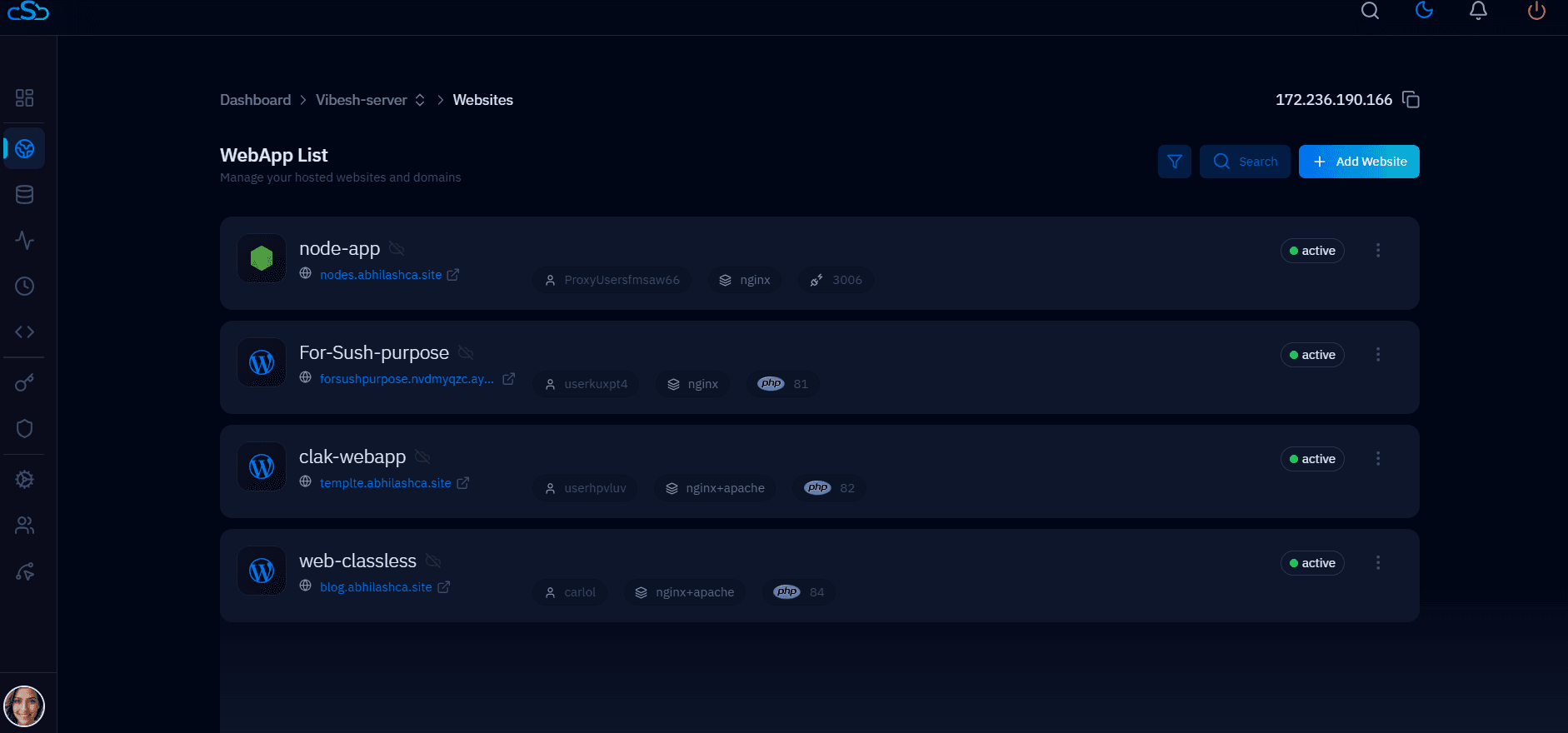
CloudStick includes all of these features as part of its standard offering. Email hosting with Dovecot and Postfix is available on all paid plans. The visual database manager lets you browse tables, run queries, and export data without leaving the dashboard. The firewall interface (powered by CSF) gives you granular control over inbound and outbound rules, IP whitelisting, and port management. SSH key management, FTP account creation, cron job scheduling, and Git deployment hooks are all available from the UI.
The matrix above reflects the current state of both products. ServerPilot covers the core LAMP-stack deployment workflow well, but nearly every capability that agencies and developers have added to their standard toolkit over the past five years is missing. CloudStick covers all of it, and continues to ship new features.
Pricing
ServerPilot offers a free plan, but its practical utility is limited. The free tier does not include SSL certificate management, PHP version selection per app, or support. For anything resembling a production hosting setup, you need the Economy plan at $5/month per server, or the Business plan at $10/month per server.
The per-server pricing model means ServerPilot costs scale linearly with your infrastructure. Manage 10 servers on the Business plan and you're paying $100/month for a panel that still doesn't include email hosting, a visual DB manager, or team seats. That's a significant spend for an incomplete feature set.
CloudStick's pricing model is flat. Pay $9/month for one server, $19/month for unlimited servers, or $49/month for unlimited servers plus white-label and extended team seats. The jump from 1 server to unlimited is only $10/month — and that price includes every feature in the product. Agencies managing 5+ servers save money on day one relative to ServerPilot, and gain a substantially more capable feature set.
WordPress and PHP
ServerPilot has always supported WordPress deployment, and for a simple one-click install it still works. You can create an app, click the WordPress installer, and have a working site in a few minutes. PHP version selection per app is available on paid plans. That's where the WordPress story ends for ServerPilot — there's no deeper integration with the WordPress ecosystem, no plugin management, no bulk actions across sites, and no WordPress-specific tooling.
CloudStick's WordPress Manager goes substantially further. Every WordPress installation on the server is surfaced in a dedicated management view where you can see plugin versions, update status, and PHP version at a glance. You can toggle debug mode, configure auto-update settings per site, manage WordPress users, and — on the Business plan — use Magic Link to log into WordPress admin without a password. WordPress Templates let you pre-configure a WordPress setup (plugins, theme, settings) and deploy it to new sites instantly.
For PHP, CloudStick supports all active PHP versions simultaneously on the same server. You can run PHP 7.4, 8.0, 8.1, 8.2, and 8.3 side by side and assign different versions to different websites without any manual configuration. The EasyPHP module lets you install extensions like imagick, redis, memcached, and xdebug from the dashboard with one click. ServerPilot supports multiple PHP versions but requires SSH access to manage extensions — there's no dashboard-level extension management.
For WordPress developers managing multiple client sites, CloudStick's WordPress Manager eliminates the need to log into each site individually to check plugin status or run updates. That time saving compounds quickly when you're managing dozens of installations.
Why Developers Are Switching
The most common reason developers cite for leaving ServerPilot is stagnation. Features that have been on the community wish list for years simply haven't shipped. When you're building a hosting business or managing infrastructure for clients, you need a panel that keeps pace with your growing requirements. A panel that hasn't added meaningful capabilities in years becomes a ceiling rather than an enabler.
Email hosting is the most frequently mentioned gap. Agencies delivering complete managed hosting to clients need to provide email — and if the control panel doesn't support it, you're either building a separate email infrastructure or routing clients to a third-party provider. Neither is ideal. CloudStick builds email hosting (Dovecot and Postfix) directly into the panel with DNS management, mailbox creation, and SMTP configuration all handled from the same dashboard.
The second major driver is pricing. Developers who scaled their infrastructure over the years found ServerPilot's per-server billing increasingly painful. At $10/month per server, a fleet of 20 servers costs $200/month for a panel that can't send email or show a database table. CloudStick Pro at $19/month for unlimited servers reframes the economics entirely — the more servers you run, the more dramatic the savings.
A third factor is the developer experience itself. CloudStick is built on a modern stack with a UI that reflects current UX standards — real-time server metrics, a clean dashboard with meaningful at-a-glance information, and a workflow that requires fewer clicks per task. ServerPilot's interface has the feel of software that was designed in a different era of the web, because it was.
Should You Move to CloudStick
If you're running ServerPilot today and are satisfied with what it does, the case for switching comes down to a few key questions. Do you need email hosting? Do you need team seats? Do you want a visual database manager? Do you manage more than two or three servers? If the answer to any of these is yes, the switch to CloudStick will improve your workflow and likely reduce your monthly spend at the same time.
Migration from ServerPilot to CloudStick follows a standard approach: connect your VPS to CloudStick (the two panels can run simultaneously on the same server for a transition period), recreate your websites, restore databases, and point DNS when you're ready. The CloudStick team has documentation covering the migration workflow, and because both panels use PHP-FPM and standard Nginx/Apache configurations, most migrations complete without complications.
If you're a solo developer running a single server and only need basic PHP deployment with no team requirements and no email, ServerPilot's Economy plan at $5/month still works as a minimal option. But for anyone beyond that minimal use case — especially agencies, freelancers who manage multiple client sites, or developers who want a panel that continues to improve — CloudStick is the stronger long-term choice.
CloudStick offers a 7-day free trial with full feature access — no credit card required. You can connect a test server, explore the WordPress Manager, email hosting, visual DB manager, and firewall controls without committing. It's the easiest way to evaluate the switch from ServerPilot with zero risk.